How to Find the Slope: Formula, Two Points & Graph (With Examples)
Slope tells you how steep a line is and which direction it goes. Whether you have two points, a graph, or an equation, finding the slope comes down to one idea: rise over run. This guide walks you through every method with clear examples, and explains slope-intercept form.
Want the answer instantly? Enter two points into our free Slope Calculator.
What Is Slope?
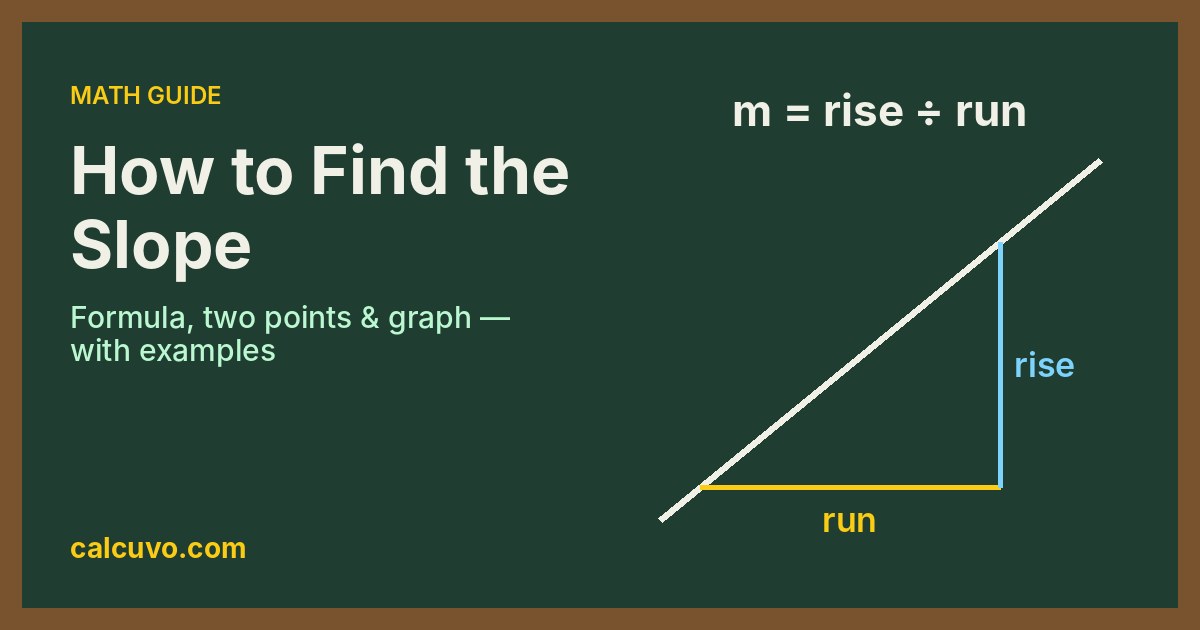
The slope of a line (usually written as m) measures how much y changes for every 1-unit change in x. In other words, it's the rise (vertical change) divided by the run (horizontal change).
- Positive slope: the line goes up from left to right.
- Negative slope: the line goes down from left to right.
- Zero slope: a horizontal line (no rise).
- Undefined slope: a vertical line (no run — you can't divide by zero).
The Slope Formula
For any two points (x₁, y₁) and (x₂, y₂):
m = (y₂ − y₁) ÷ (x₂ − x₁)
How to Find Slope With Two Points
Example 1: Find the slope of the line through (1, 2) and (4, 8).
- Label the points: x₁ = 1, y₁ = 2, x₂ = 4, y₂ = 8
- Rise: y₂ − y₁ = 8 − 2 = 6
- Run: x₂ − x₁ = 4 − 1 = 3
- Slope: m = 6 ÷ 3 = 2

Example 2 (negative slope): Points (−2, 5) and (3, −5).
- Rise: −5 − 5 = −10
- Run: 3 − (−2) = 5
- Slope: m = −10 ÷ 5 = −2
Tip: It doesn't matter which point you call "first," as long as you subtract in the same order on top and bottom.
How to Find Slope on a Graph
- Pick two points where the line crosses grid lines exactly.
- Count the rise: how many units up (+) or down (−) from the first point to the second.
- Count the run: how many units right from the first point to the second.
- Divide rise by run.
In the graph above, going from (1, 2) to (4, 8) rises 6 and runs 3, so the slope is 6 ÷ 3 = 2.
What Is Slope-Intercept Form?
Slope-intercept form is the most common way to write a linear equation:
y = mx + b
- m = the slope
- b = the y-intercept (where the line crosses the y-axis)
For example, in y = 2x + 3, the slope is 2 and the y-intercept is 3. Learn more in our guide on how to find the y-intercept.
How to Find Slope From an Equation
Rearrange the equation into y = mx + b, then read off m.
Example: 4x + 2y = 10
- Subtract 4x: 2y = −4x + 10
- Divide by 2: y = −2x + 5
- Slope: m = −2
Shortcut for standard form Ax + By = C: slope = −A ÷ B. Here, −4 ÷ 2 = −2.
Common Mistakes to Avoid
- Mixing up the order — subtracting y₂ − y₁ on top but x₁ − x₂ on the bottom flips the sign.
- Putting x on top — slope is change in y over change in x, not the other way around.
- Forgetting negative signs when subtracting negative coordinates.
- Dividing by zero — if x₂ − x₁ = 0, the line is vertical and the slope is undefined.
Frequently Asked Questions
How do you find slope with two points?
Use m = (y₂ − y₁) ÷ (x₂ − x₁): subtract the y-values, subtract the x-values in the same order, and divide.
What is slope-intercept form?
It's y = mx + b, where m is the slope and b is the y-intercept.
What is the slope of a horizontal line?
Zero. A horizontal line has no rise.
What is the slope of a vertical line?
Undefined, because the run is zero and you can't divide by zero.
Can slope be a fraction?
Yes. A slope of 2/3 means the line rises 2 units for every 3 units it runs. Simplify fractions with our Fraction Calculator.
Related Math Guides & Tools
Final Thoughts
To find slope, remember rise over run: m = (y₂ − y₁) ÷ (x₂ − x₁). Use two points, count it on a graph, or rewrite the equation as y = mx + b. Double-check your answer anytime with the free Calcuvo Slope Calculator.