Weighted vs. Unweighted GPA: Differences & How to Calculate
Your high school transcript might show two different GPAs — a weighted GPA and an unweighted GPA. They're built from the same grades but calculated differently, and the gap between them can be large. This guide explains what each one means, how to calculate them, and which one colleges actually look at.
Calculate your GPA in seconds with our free GPA Calculator.
What Is an Unweighted GPA?
An unweighted GPA uses the standard 4.0 scale and treats every class the same, regardless of difficulty. An A in regular English and an A in AP Calculus are both worth 4.0.
- A = 4.0, A- = 3.7
- B+ = 3.3, B = 3.0, B- = 2.7
- C+ = 2.3, C = 2.0
- D = 1.0, F = 0.0
The maximum unweighted GPA is 4.0.
What Is a Weighted GPA?
A weighted GPA gives extra points for more challenging courses. The most common system adds:
- +0.5 for honors classes (an A = 4.5)
- +1.0 for AP, IB, or dual-enrollment classes (an A = 5.0)
Because of these bonuses, weighted GPAs usually range up to 5.0. Some schools use different bonuses, so always check your school's scale. Learn more in What Is the Highest GPA You Can Get?
Weighted vs. Unweighted GPA: Example
Here's how the same four grades produce two different GPAs:

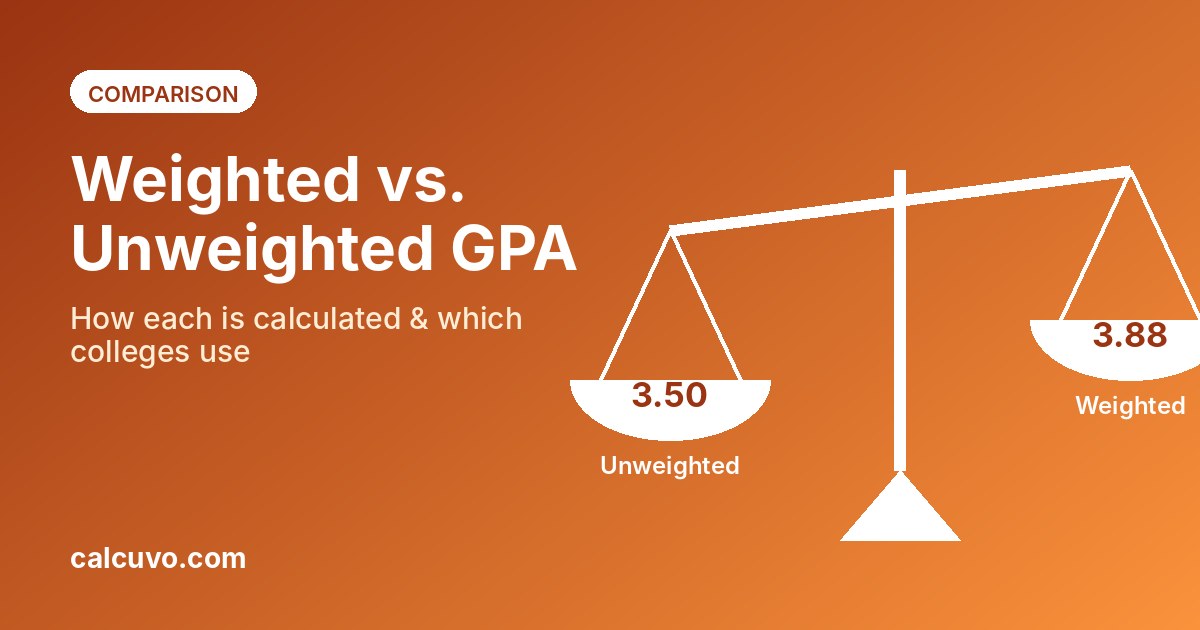
- Unweighted: (4.0 + 3.3 + 3.0 + 3.7) ÷ 4 = 3.50
- Weighted: (5.0 + 3.8 + 3.0 + 3.7) ÷ 4 = 3.88
The AP and honors bonuses raise the weighted GPA by nearly 0.4 points, even though the grades are identical.
How to Calculate Weighted GPA
- Convert each letter grade to its 4.0-scale value.
- Add +0.5 for each honors class and +1.0 for each AP/IB class (or your school's bonus).
- Multiply each value by the class's credits.
- Add everything up and divide by total credits.
To calculate unweighted GPA, skip step 2. Our GPA Calculator does the math for you.
How to Calculate High School GPA
High school GPA is usually calculated per semester and then combined into a cumulative GPA across all four years. Most schools only count core academic classes, though some include electives. For the full method, see What Is Cumulative GPA and How to Calculate It.
Which GPA Do Colleges Look At?
Both — and often neither exactly as reported. Because every high school weights grades differently, many colleges recalculate GPAs using their own method (often unweighted, core courses only). What they always consider:
- Course rigor: did you take the most challenging classes available to you?
- Grades in those classes: a B in AP can be viewed favorably compared to an A in an easier class.
- Grade trend: improving grades over time help your application.
Which Is Better: Weighted or Unweighted?
Neither is "better" — they measure different things. An unweighted GPA shows your raw performance, while a weighted GPA also reflects the difficulty of your schedule. When comparing yourself to college averages, make sure you're comparing the same type of GPA. See typical benchmarks in What Is a Good GPA?
Frequently Asked Questions
What is a weighted GPA?
A GPA that gives extra points for honors, AP, or IB classes, so it can go above 4.0 — usually up to 5.0.
Is a 4.0 weighted GPA good?
Yes, it's a strong GPA. But because weighted GPAs can reach 5.0, a 4.0 weighted may reflect some B's balanced by AP or honors A's.
Is a 3.5 unweighted GPA good?
Yes. A 3.5 unweighted is above average and competitive for many colleges. Read more in Is a 3.5 GPA Good?
Do colleges prefer weighted or unweighted GPA?
Many colleges recalculate GPAs their own way and focus on the rigor of your courses alongside your grades.
Final Thoughts
Your unweighted GPA shows how well you did, and your weighted GPA shows how well you did in harder classes. Know both numbers before you apply — and calculate them accurately with the Calcuvo GPA Calculator.