How to Find the Y-Intercept (With Two Points, Equations & Graphs)
The y-intercept is one of the most useful ideas in algebra — it tells you where a line crosses the y-axis. In this guide you'll learn what the y-intercept is and how to find it from an equation, from two points, from a point and slope, or straight from a graph, with step-by-step examples. We'll also cover how to find the x-intercept.
Need to find slope first? Our free Slope Calculator does it instantly.
What Is the Y-Intercept?
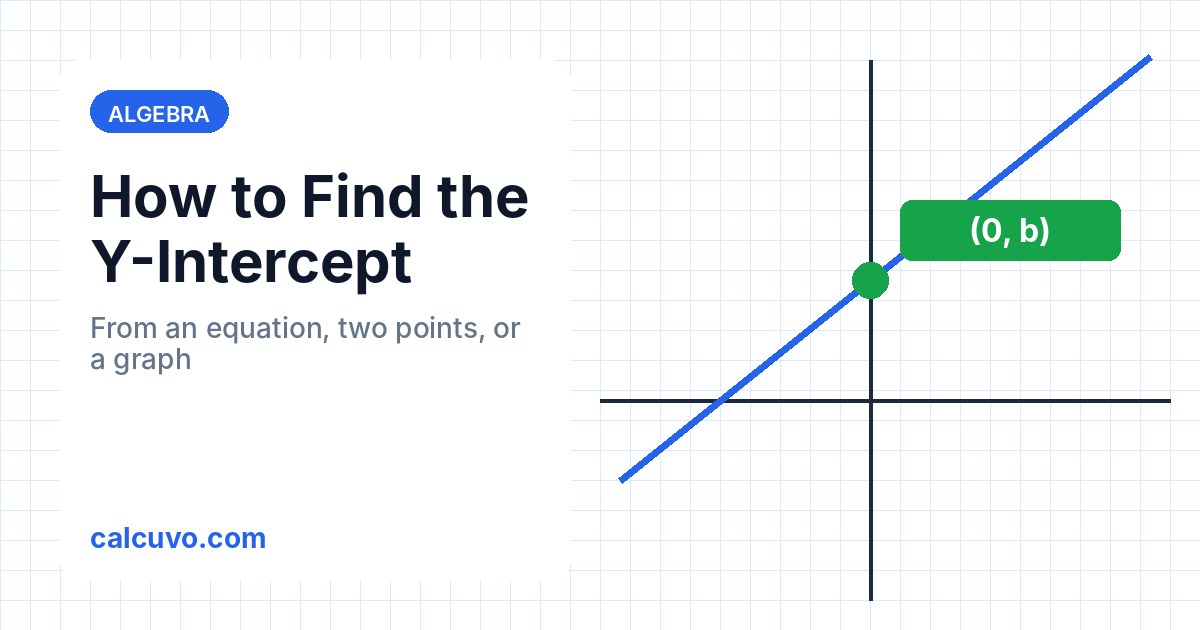
The y-intercept is the point where a line (or curve) crosses the y-axis. At that point, x = 0. It's written as a coordinate (0, b), or often just as the value b.
In the slope-intercept form of a line, y = mx + b, the letter m is the slope and b is the y-intercept.

How to Find the Y-Intercept From an Equation
Method 1: Slope-intercept form (y = mx + b)
If the equation is already in the form y = mx + b, just read off b.
Example: y = 2x + 3 → the y-intercept is 3, so the point is (0, 3).
Method 2: Plug in x = 0
For any equation, set x = 0 and solve for y. This works for standard form and other equations too.
Example: 3x + 2y = 12
- Set x = 0: 3(0) + 2y = 12
- 2y = 12, so y = 6
- The y-intercept is (0, 6).
How to Find the Y-Intercept With Two Points
When you're given two points, first find the slope, then solve for b.
Example: Find the y-intercept of the line through (2, 7) and (4, 11).
- Find the slope: m = (11 − 7) ÷ (4 − 2) = 4 ÷ 2 = 2
- Plug one point into y = mx + b: 7 = 2(2) + b
- Solve for b: 7 = 4 + b, so b = 3
- The y-intercept is (0, 3).
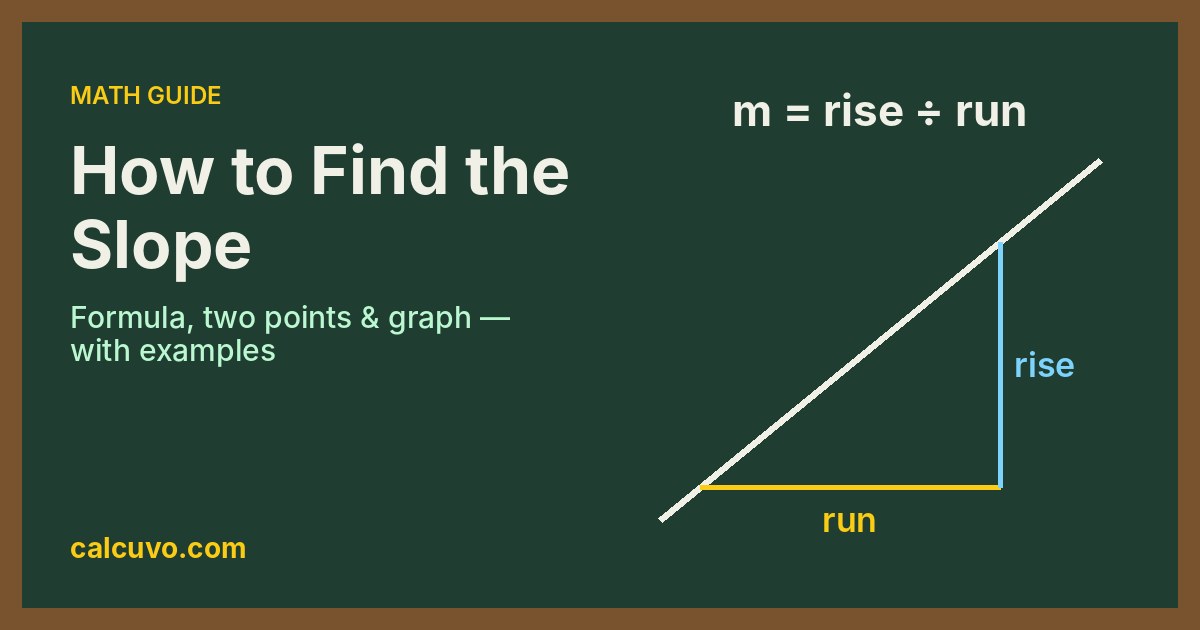
Not sure about step 1? Read our full guide on how to find slope, or plug the points into the Slope Calculator.
How to Find the Y-Intercept From a Point and Slope
Use the shortcut b = y − mx.
Example: slope m = −3, point (1, 5)
- b = 5 − (−3)(1) = 5 + 3 = 8
- The equation is y = −3x + 8, and the y-intercept is (0, 8).
How to Find the Y-Intercept on a Graph
- Locate the vertical y-axis (where x = 0).
- Follow the line until it crosses the y-axis.
- Read the y-value at that point. That's your y-intercept.
In the graph above, the line y = 2x + 3 crosses the y-axis at (0, 3).
How to Find the X and Y Intercepts
The x-intercept is where a line crosses the x-axis, so y = 0 there. To find both intercepts:
- Y-intercept: set x = 0 and solve for y.
- X-intercept: set y = 0 and solve for x.
Example: 3x + 2y = 12
- y-intercept: x = 0 → 2y = 12 → (0, 6)
- x-intercept: y = 0 → 3x = 12 → (4, 0)
For y = 2x + 3, the x-intercept is 0 = 2x + 3 → x = −1.5, so (−1.5, 0).
Special Cases
- Horizontal line (y = 4): the y-intercept is (0, 4), and there's no x-intercept (unless the line is y = 0).
- Vertical line (x = 5): there's no y-intercept, because the line never crosses the y-axis.
- Line through the origin (y = 3x): the y-intercept is (0, 0).
Frequently Asked Questions
What is the y-intercept?
It's the point where a line crosses the y-axis, written as (0, b). In y = mx + b, it's the value b.
How do you find the y-intercept with two points?
Find the slope m from the two points, plug one point into y = mx + b, and solve for b.
How do you find the y-intercept of an equation?
Set x = 0 and solve for y.
Can a line have no y-intercept?
Yes. A vertical line like x = 5 never crosses the y-axis, so it has no y-intercept.
What's the difference between slope and y-intercept?
Slope (m) tells you how steep a line is; the y-intercept (b) tells you where it starts on the y-axis.
Related Math Guides & Tools
- How to Find the Slope: Formula, Two Points & Graph
- Slope Calculator
- Scientific Calculator
- Fraction Calculator
Final Thoughts
To find the y-intercept, remember one rule: it's where x = 0. Read b from y = mx + b, plug in x = 0 for any other equation, or use two points to find the slope and solve for b. Check your work anytime with the free Calcuvo Slope Calculator.