Is a D a Passing Grade in College and High School?
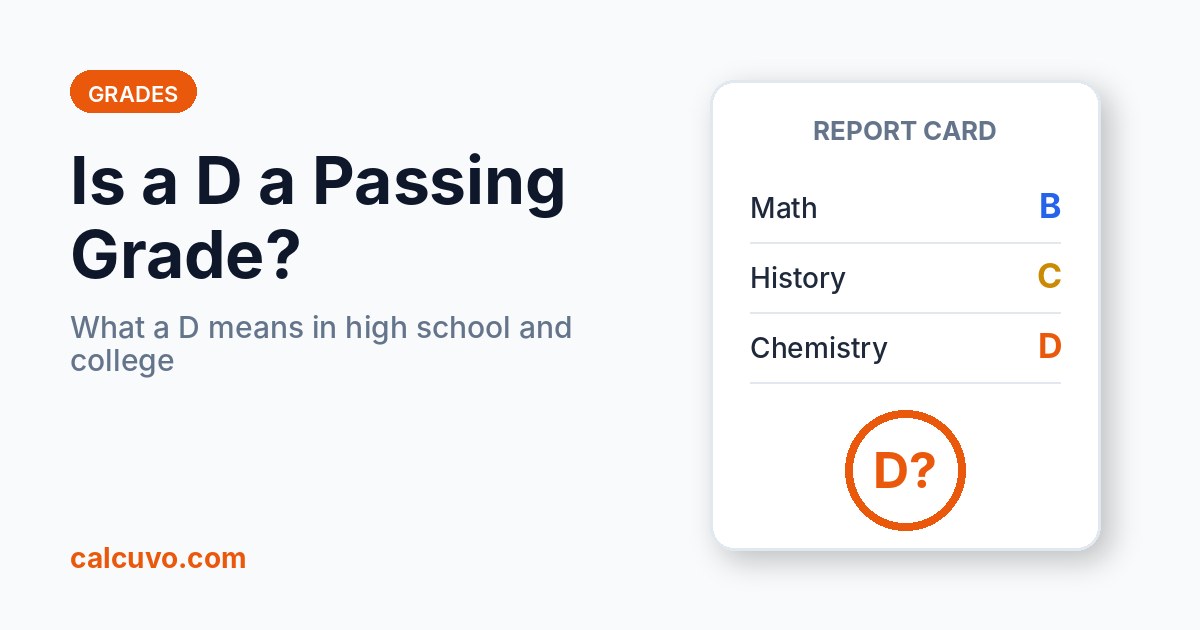
Got a D on your report card or transcript and wondering if it counts? The short answer: yes, a D is usually a passing grade — but it often isn't "passing enough." A D can earn you credit while still failing to meet requirements for your major, prerequisites, or graduation. Here's exactly what a D means in high school and college.
Want to know the score you need to pull your grade up? Try our free Grade Calculator.
Is a D a Passing Grade? (Quick Answer)
- Technically: Yes. At most US high schools and colleges, a D is the lowest passing grade, and F is failing.
- Percentage: A D is usually 60–69%. Anything below 60% is typically an F.
- GPA value: A D equals 1.0 grade points on the 4.0 scale (D+ = 1.3, D- = 0.7).
- The catch: Many programs require a C or C- or higher for a class to count toward your major or as a prerequisite.

Is a D Passing in College?
In most colleges, a D earns credit hours, so it counts as passing for general credit toward graduation. However, it frequently does not count for:
- Major or minor courses, which often require a C or better.
- Prerequisites — you may need to retake the class before moving to the next level.
- Transfer credit, since many colleges only accept transfer courses with a C or higher.
- General education requirements at some schools.
Always check your college catalog or ask your academic advisor for the exact rule.
Is a D Passing in High School?
In most US high schools, a D is a passing grade and earns course credit toward graduation. Some districts set the passing line higher (for example, 65% or 70%), so a D may be failing in those schools. Keep in mind that colleges see every grade on your transcript, and some colleges won't accept a D in required college-prep courses.
How Does a D Affect Your GPA?
A D is worth just 1.0 grade points, compared to 4.0 for an A. That makes it a heavy drag on your average — especially in a high-credit class. For example, one D in a 4-credit class alongside three A's in 4-credit classes drops a perfect 4.0 down to a 3.25.
Calculate how a D changes your average with our GPA Calculator, and see where your number lands in What Is a Good GPA?
Can a D Hurt Your Financial Aid?
It can. Many scholarships and financial aid programs require you to maintain a minimum GPA (often 2.0, sometimes 3.0) and to complete a certain share of your attempted credits. A D on its own may not break these rules, but several D's can pull your cumulative GPA below the cutoff.
What to Do If You Get a D
- Check if the class counts. Confirm whether a D meets your major, prerequisite, or graduation requirements.
- Look into grade replacement. Many schools let a retake replace the original D in your GPA.
- Talk to your advisor or teacher about extra credit or recovery options.
- Plan your next exams. Use the Grade Calculator to see exactly what you need on your final.
- Balance it out with strong grades in your other classes to protect your overall GPA.
Frequently Asked Questions
Is a D a passing grade in college?
Usually yes for general credit, but many majors and prerequisites require a C or higher.
What percentage is a D?
On the most common US scale, a D is 60–69%. Some schools use slightly different cutoffs.
Is a D- passing?
At most schools that use D-, it's the lowest passing grade (often around 60–62%), worth 0.7 grade points.
Is a 65 a passing grade?
On a standard scale, 65% is a D, which is passing at most schools — but check your school's policy.
Does a D count as credit?
Generally yes, though it may not satisfy specific course or program requirements.
Related Guides
- Is a 3.5 GPA Good? What Every GPA from 2.0 to 4.0 Means
- What Is a Good GPA?
- Weighted vs. Unweighted GPA
Final Thoughts
A D is usually passing but risky: it earns credit, yet it can block your major, prerequisites, or transfer plans and drag down your GPA. If you're close to a D, use the Calcuvo Grade Calculator to figure out what you need to move up a letter.